

Time has taught me that being an outsider is a superpower. You don’t think like everyone else, which means you can do what businesses love most: you can identify opportunities and execute in ways that surprise and delight stakeholders beyond the company’s walls. Being an outsider makes you alpha in human form. Where others overly familiar with a field may tack left, outsiders will move at a right diagonal. They’ll travel a Z-axis when others trained in a field assume there is only X and Y.
Today, HP announced Emma Walmsley as the company’s new CEO. Prior to leading HP, Walmsley was the CEO of GSK Plc. While there, Walmsley “survived an activist campaign led by Elliott Investment Management, which questioned her suitability to run GSK given her lack of a scientific background.” At HP, she will need to figure out how to navigate rapidly rising memory chip costs and its impact on demand for HPs consumer products, the integration of artificial intelligence across the company, and the impact of AI on HP’s workforce. As an outsider myself, I am excited to see how she takes on these challenges and cultivates wins in unexpected ways.
Meanwhile, Bloomberg has a profile of the hedge fund, D.E. Shaw, which has what many would consider an unconventional hiring and talent retention style, opting for “English majors, philosophy grads, Broadway actors, the occasional writers-workshop MFA or modernist painter.” They also don’t fire people for mistakes. Instead, they double down on that talent, putting their money behind an ironclad principle in business: failure breeds more learning than success, and learning is one of a company’s most valuable assets.
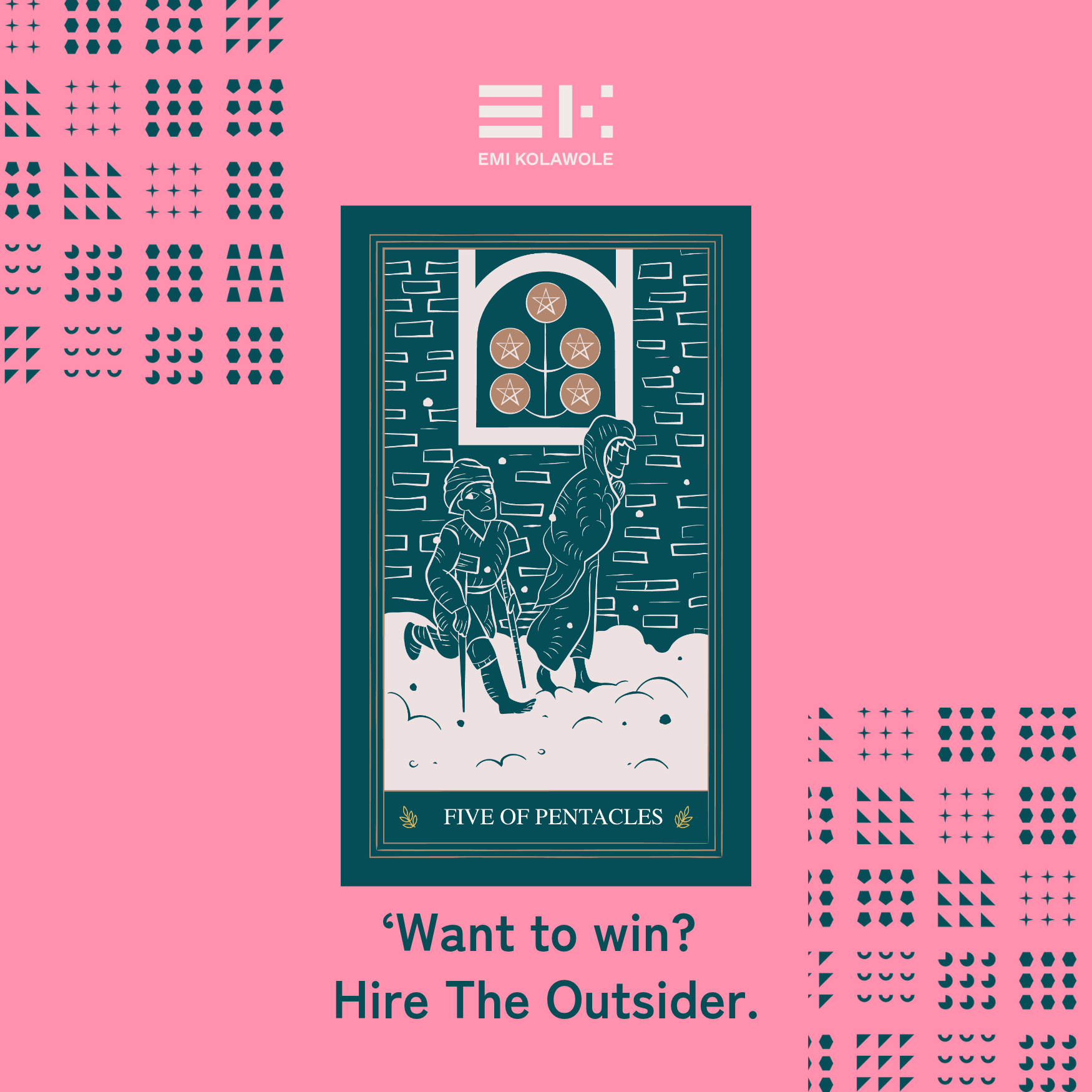
When I worked in Big Tech, being an outsider felt like torture. Similar to middle school, it always felt like I was wearing the wrong outfit or that I wasn’t up on the lingo the cool kids knew backwards, forwards, and upside down. Even in my tarot practice, I kept drawing the Five of Pentacles – a card that depicts what appear to be two beggars walking outside in the snow, passing by what looks to be a warm and inviting house of worship. I often read the card as a choice. I could always choose to just walk in the church, get warm, and probably eat a nice meal. Or I could choose to continue to struggle through the cold.
Now, I see that card differently. The church wasn’t the company or its technical teams (I worked with some truly lovely people) and my resistance to assimilation. The church was me, and the choice was whether to accept or reject myself. Was I willing to accept my unique talents and my ability to come up with novel solutions that broke the mold – that broke the box of others’ assumptions about what was possible? Or was I going to give myself over to group think? In the time since I left, I’ve learned that I have many good ideas, and every once in a while I have truly great ones. I am comfortable with my nature, which is to think outside of the box, explore a broad array of subjects and interests, and to take risks. I enjoy reading a room and zooming out to observe systems and use those observations to see around corners. In short, I am a born outsider, and I am at my best in that role.
The job market today is focusing more and more on people with narrow skills and highly specific proof points. Interviewers want to know by what percentage you increased sales in your last role, even when the role you’re applying for isn’t a sales job. They want you to put specifics that challenge the boundaries of your non-disclosure agreement all across your resume as proof that you are the perfectly-fit puzzle piece for a given job. It’s a bad strategy. Why push people to present and operate as robots when you can now buy robots (excuse me, AI agents) in the hundreds and thousands?
Instead, hire people for the skills that, on the surface, appear to run orthogonal to your goals. Empower people who are clearly smart, capable, and hard-working but who are also creative, thoughtful, and whose resumes look a little bit weird. These are the people who, in an age where everything is being regressed to the mean by machines (literally), will breathe life into your company, accelerate learning through trial and error, and give your team the magic you need to win.