

The movie theater is back on my list of weekend appointments. I always get a large cheddar popcorn and a Coke Zero – they’re my weekend treats after a solid week of (mostly) healthy eating. The lights dim, I recline the seat, and I settle in.
The weekend before last, I went to see the A24 documentary, “You Can See Everything”. The film shattered every assumption I had about what a documentary could be. If it doesn’t win an Oscar, I will be shocked. There are some in the film world who argue it has unlocked an entirely new genre – one that is part documentary, part something else entirely. If, like me, you were a fan of “Nathan For You” and “The Rehearsal”, you were at least somewhat prepared for a bit of a mind-bender. The filmmaker outdid himself with “You Can See Everything”. I left the theater feeling as if I had re-lived the entire Silicon Valley chapter of my life over again in a matter of hours. The reality-bending rhetorical tricks and the picking and choosing of facts to frame a reality teleported me back in time to the decade I spent living in Palo Alto – a decade that started when Holmes’ face graced the cover of nearly every business and technology magazine. I left the theater feeling like something deep inside was simultaneously vindicated and healed.
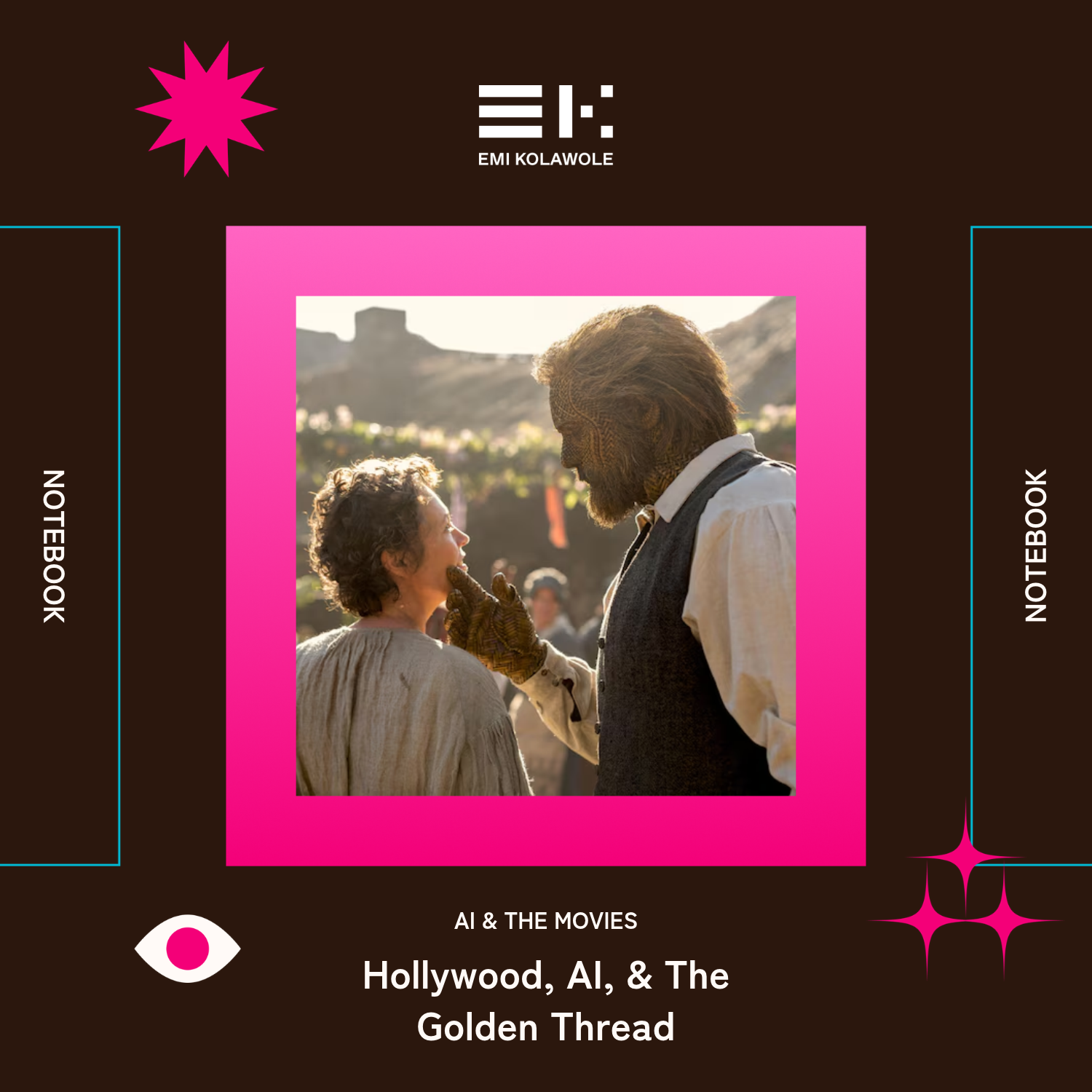
This past weekend I went on what I thought would be a very different journey with “Wicker” – the romantic fantasy based on the short story “The Wicker Husband” by Ursula Wills-Jones. The film was funny, poignant and, surprisingly, just as validating as Fielder’s “You Can See Everything”. “Wicker” introduces a paradigm for relationships that more closely aligns to what many women want. It validated my instinct to question and critique the romantic tropes I was steeped in as a child while healing wounds those old narratives had left behind. I’ll stop there so I don’t drop any spoilers.
These experiences rest against the backdrop of the film industry as a whole and the ways it has been intertwined with the evolution of artificial intelligence. AMC reported its highest-revenue quarter ever and its “second consecutive record-setting quarter”. However, stocks appear to be taking a slide today, likely because two record quarters do not make a trend. This comes as investors are starting to question whether AI spending is sustainable and the first all-AI generated film in China flopped.
Here’s the takeaway: Both AI and film appear to be doing well and poorly at the same time. The industries seem kind of lumpy. Record profits, record spending, but a persistent undercurrent of doubt from investors and skepticism from consumers.
Running deep within these two industries is an important golden thread practitioners can never afford to forget: humans love stories, novelty, and coming together in groups.
We are still going to the movies because filmmakers, actors, producers, directors, and artisans offer us these three things simultaneously inside of a theater. We put our money and time into films that pluck the golden thread with conviction and a strong point of view. We don’t want to see a film for the sake of the technology used to make it. We want to see a film because the people who made it, regardless of the technology they used, inspired us to come together around the light of a screen just like we came together around the light of the fire in ancient times.
I went to see “The Odyssey” twice because the story, as old as it was, was told in a novel way – and the second time I got to see it with one of my best friends. Coming together with her to see that movie made for one of the best experiences of my life. Even though I went to see “You Can See Everything” and “Wicker” by myself, it was fun to sit in a theater and hear everyone laughing, gasping, and groaning along with me.
Those of us working on building new artificial intelligence tools and integrating them into day-to-day work (including filmmaking) can’t afford to lose sight of the golden thread. We need to ask ourselves whether what we’re building and how we’re deploying it is delivering novelty, whether it’s bringing people closer together or tearing them further apart, and whether it is making rich and dynamic stories or hollow remixes.
I am a media professional building an AI company. I know AI unto itself isn’t bad for the entertainment industry. In fact, media professionals have so much to teach AI developers about where the golden thread is and its power. The fact AI was developed in the absence of creatives while hoovering up their work product is, at least in part, why the AI industry is struggling now under doubt and suspicion.
The film industry has historically embraced new technologies, and it can’t (and it won’t) stop with AI. The challenge now is for these industries to come together and recognize and respect the golden thread. It will take more work, not less, but it will unlock both AI and Hollywood’s mutual, long-term success.